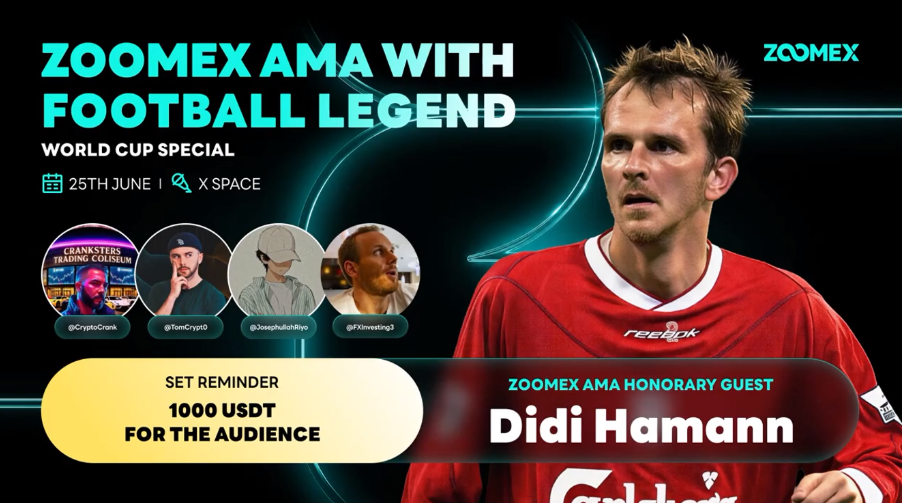
Zoomex X Space Recap With Didi Hamann and the World Cup Trading Panel

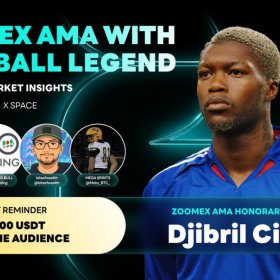
Zoomex hosted the second episode of its World Cup Edition X Space as part of the Zoomex World Cup Impact Pledge, bringing together Champions League winner Didi Hamann and three traders: Mario from Forex Trading & Investing, Crank, and Joseph. Fernando Aranda hosted the session, which ran across World Cup analysis, the German squad debate, career philosophy, and the kind of crypto-to-football comparisons that only hold together when neither side takes them too seriously.
The session continued the five-part charity initiative launched in the first episode. Across five World Cup episodes, Zoomex is committing 1,000 USDT per episode to a charity of each football guest’s choosing, rising by an additional 5,000 USDT if the guest’s World Cup prediction proves correct. Hamann backed Japan to beat Sweden and nominated a homeless support charity in Munich, a cause he backs regularly.
Nothing to Lose. Nothing to Fear.
Fernando opened by asking which is harder, a match you must win, or a match you cannot afford to lose. Hamann said the question had never been put to him that way before, and his answer repositioned the difficulty entirely.
“I always say in football, the hardest thing in football is when you play against a team that has nothing to lose. If that makes sense, because we’ve seen a lot of upsets. When a team has nothing to lose, they’re the most dangerous because they just go for it. And if they lose, they lose. It doesn’t matter. But if they win, they can win everything or gain everything.”
That is a different pressure to manage than needing to win. A team chasing a must-win result still operates inside a calculation. A team that only stands to gain has discarded the calculation entirely. From that point of view, he said, having to win is probably the easier of the two situations to be in.
Morocco against Italy was the recent example the panel kept returning to. South Africa against South Korea was another. “Nobody gave them a chance, and here they are in the last 32.”
Crank had watched the same dynamic unfold in markets many times. Traders who enter without a prebuilt plan are playing from the same emotional state as a team with nothing to lose: exposed, reactive, and without the protection that structure provides. The difference is that in trading, the cost of that freedom comes directly out of your account.
The Game Does Not Change at 3-0 Down.
As a holding midfielder, Hamann gave himself one instruction regardless of what the scoreboard said, and he never deviated from it.
“I always felt in my position I couldn’t afford to give the ball away because we have players who need to take risks. They give the ball away more often naturally because they have to take chances. And I always felt in my position I had to play the same way whether we are 3-0 up or 3-0 down because I wasn’t the one changing games, scoring goals or setting up goals. It wasn’t my job and I couldn’t do it. But we had players to do that.”
The players around him were Steven Gerrard, Luis Garcia, Cissé, Baros. His job was to win the ball, protect the structure, and put it in their feet as quickly as possible. Getting carried away when the scoreline was comfortable, or trying to do things that were not in his nature when 3-0 down, both produced the same result: a team that had lost its shape.
Istanbul in 2005 is the case study. Hamann came on at half-time, three goals down against an AC Milan side regarded at the time as the best club team in the world. He was warming up on the touchline when the second half was about to begin, and his read was simple.
“I was sure, warming up at half-time, because obviously I came on at half-time, I was sure if we scored one, I’m sure we scored a second one. And then if it’s 3-2, even the most experienced teams do make mistakes. And then after that first goal, the stadium came, there were 40,000 or 50,000 Liverpool fans. And I think AC Milan all of a sudden thought, maybe it’s not over.”
Three goals in six minutes. Penalties after that. He acknowledged luck was part of it, but the more durable point was that the process did not change. Win the ball. Do not concede the wrong goal. Give the ball to the people with the license to take risks.
Cissé had been a guest the previous week and described the same locker room from the other side. Joseph in this session brought the parallel into trading directly: “I always start with a plan, like a coach picks his starting eleven before the match. But if the market moves against me, don’t wait too long. Just like a coach, make a quick substitution when the team is losing control. I exit my position early instead of hoping for a comeback. Sticking to a plan is good, but being too stubborn can really hurt you. At the end of the day, the best traders are not the ones who are always right. They are the ones who know how to manage risks when they are wrong.”
Attack Is Not Enough.
Fernando raised the old argument: attack wins games, defence wins championships. Hamann agreed, then sharpened it.
“It’s almost impossible to outscore teams on a regular basis. I do think just attack won’t win. You need a good defence, you need a balance in your team, and a good-holding midfielder. You might get to the quarters, you might get to the semis, you might even get to the final. But I don’t think you win the whole thing.”
The Barcelona side that most people reach for as the purest attacking team of the modern era, Messi, Suárez, Neymar, still had Puyol and Piqué in central defence and Busquets holding midfield. That Busquets point is the sharper one: the best attacking team of the generation was built around arguably the best defensive midfielder of the same generation. France in this tournament ticks the same boxes from the other direction. Mbappé at the front, two of the best centre-backs in the world behind him, a holding structure that does not give teams the space to breathe.
Real Madrid is the present-day example of what happens when the balance is off. The attacking quality is not in question. The defensive midfield structure lags, and at the tournament stage, one bad half against the right opponent ends everything.
On the type of error he finds hardest to watch, Hamann drew a precise distinction. “I don’t mind the technical fault or mistake. You know, if a ball bounces, if you misplace a pass, it shouldn’t happen, but it happens. But what I don’t like is when teams, especially in the Champions League or now in the World Cup, when they make mental mistakes. You see it all the time when they give the ball away in areas where they shouldn’t play, where they get a bit too smart and think they get away with it. You shouldn’t make a mistake because you don’t think. This is what drives me crazy.”
A technical error can be explained by the surface, by fatigue, by a fraction of a second lost to distraction. A mental error has no comparable excuse. At the highest level, with everything on the line, the only reason to stop thinking is overconfidence.
The trading panel had the same split. Mario put it cleanly: “The market is the man and we follow the market. It doesn’t make sense not to change your view if the market is against you. You only lose money when you do it like that.” The stop loss is the instrument that enforces honesty when the mind is arguing for one more minute, one more candle, one more reason to stay in. Mario gave it the most useful name of the session: “The stop loss is like being a good defender. Maybe like the libero. The last man. If you kick him, then you get a red card. That’s the stop loss. Last line of defence.”
Joseph extended the metaphor into position sizing: “It’s just like a football defence. If your back line is not organised, even a great goalkeeper cannot save you every time. In trading, protecting your capital is like protecting your goal. If you defend well, you will always have another chance to win.”
Brazil to Win. Angelotti to Manage.
Hamann had made his tournament pick before the first game was played, and he was not changing it now.
“I said at the start of the tournament, I said Brazil, because I think it’s a long tournament. It’s 48 teams now, so it’s a week, 10 days longer than it was before. And there will be at times, there will be a few problems within the team, and you need somebody to handle it and manage it. And I think in Angelotti, they’ve got the perfect man.”
The best defence. A very good attack. An open question in midfield. And the right coach for a campaign that will test squads not just tactically but in terms of internal management. His second breath went to France. “I stick with Brazil, but I think it will take a very, very good team to beat France.”
Germany occupies a different kind of space in Hamann’s thinking, somewhere between professional assessment and obvious personal investment. The read on the squad was honest. Undaf, used so far as the impact substitute, should stay there.
“He’s probably the best sub, the super sub of this tournament. He’s probably the best player coming on in this tournament. So why change it? Because everybody knows when he comes on, there’s a boost going around the ground. There’s a boost going through the team and everybody goes, oh, he’s coming on. We’ve got a chance.”
That psychological effect disappears the moment he becomes expected from the first whistle. The weapon works because it has been withheld. Sané has not delivered on the first two games. Wirth is settling in. Musiala, five months back from a serious injury, has been anonymous by his own standards. Schlotterbeck’s absence has cost the defensive structure its balance with the left foot. Mecha has been the best German player in the tournament and may emerge from it as one of the most watched midfielders in Europe.
On the group stage as a concept, Hamann was pragmatic. “You just have to get out of the group. Nobody talks. Once you get to the last 32, last 16, nobody cares how you got out of the group, how you played in the group. That’s when it matters.”
Crank’s read on the Bitcoin market was built with the same long-cycle logic. He described taking short positions near the top, closing them on the way down, and watching the four-year cycle move toward what he sees as a floor. “Bitcoin is exactly where it should be. My levels right now are golden pocket between 54 and 57. I’m waiting for one more big capitulation, scare you pretty bad, and then we can, based off of four-year cycle theory, start our accumulation phase and bottoming out, which for me is between 41 to 46,000.” Mario put his own range at 43,000 to 45,000 and believed the bottom would arrive within 100 days of the session. Joseph agreed with the range. The disagreement was mostly about timing.
Источник: BeInCrypto
Новости в мире криптовалют
Случайная цитата о деньгах
"В бизнесе ты получаешь либо деньги, либо опыт. Бери опыт, а деньги придут."


* для поиска по базе прокси просто вводите название страны, например: Россия, США, Таиланд